
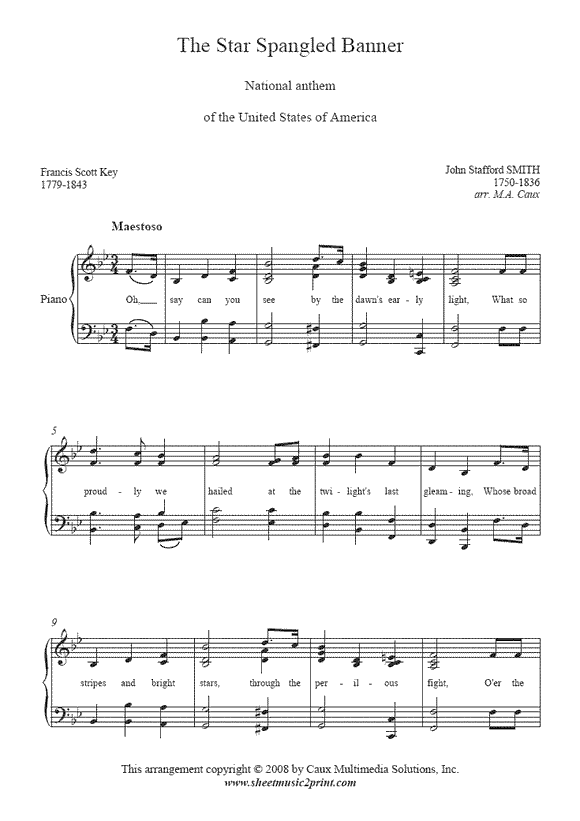
Star-Spangled Banner Sheet Music: A Guide for Singers and Musicians
“The Star-Spangled Banner” is one of the most recognizable songs in the United States. Whether you’re preparing for a school event, a sporting occasion, a concert, or a personal performance, the right sheet music can help you learn the melody and perform it with confidence.
A Brief History of the Anthem
The lyrics were written by Francis Scott Key in 1814 after he witnessed the bombardment of Fort McHenry during the War of 1812. They were set to the melody of “To Anacreon in Heaven,” a popular British song. In 1931, Congress officially designated “The Star-Spangled Banner” as the national anthem of the United States.
Choosing the Right Sheet Music
Sheet music is available in arrangements for solo voice, piano, guitar, choir, band, orchestra, and many individual instruments. Before choosing an edition, consider who will perform it and the setting. A singer accompanied by piano may need a vocal score, while a school band will need parts arranged for its particular instruments.
For singers, the key is especially important. The anthem covers a wide vocal range, and the original melody can be challenging to sing comfortably. Look for an arrangement in a key that suits the performer’s range, or ask a music teacher or accompanist about transposing it. Instrumental players should check the arrangement’s key, range, and difficulty level as well.
Reading and Practicing the Music
Start by listening to a reliable reference recording while following the notation. This can help you connect the printed notes with the melody and rhythm. Practice slowly at first, paying attention to phrasing, sustained notes, and changes in dynamics. Singers may find it helpful to mark breaths in the score; instrumentalists can note places to breathe or turn pages.
The anthem’s opening is measured and lyrical, while the closing section builds toward a dramatic finish. Practicing those sections separately can make the full performance feel more controlled. If you’re performing with a group, rehearse with the accompanist or ensemble so everyone agrees on the tempo, introduction, and ending.
Finding Sheet Music
Printed editions can be found through music stores, libraries, schools, and reputable online sheet-music services. Some sites also offer downloadable scores. Check the arrangement details before purchasing or printing: confirm the instrument or voice type, key, skill level, and whether the file includes accompaniment or separate parts.
The anthem’s original lyrics and melody are generally considered public domain in the United States. However, a newer arrangement, edition, recording, or engraving may be protected by copyright. Check the rights information supplied with the sheet music before copying, distributing, or using it publicly.
Preparing for a Performance
For a formal event, ask the organizer about the expected arrangement, performance length, and whether the audience will sing along. A clear, well-practiced score can make preparation easier and help performers focus on delivering the song respectfully and confidently.
With an arrangement suited to the performer and a little thoughtful practice, “The Star-Spangled Banner” can be approached as both a musical challenge and an opportunity to share a familiar piece of American history.
9 Tips for Choosing and Using “The Star-Spangled Banner” Sheet Music
- Choose a key that fits your vocal range.
- Check the arrangement’s difficulty level.
- Use a version with clear lyrics and chords.
- Notice the meter and rhythmic feel.
- Practice the opening pickup carefully.
- Mark breaths before long phrases.
- Keep the melody steady and expressive.
- Compare editions for your instrument.
- Use a legible, properly sized printout.
Choose a key that fits your vocal range.
Choose a key that fits your vocal range so you can sing “The Star-Spangled Banner” comfortably and confidently. The melody spans a wide range, and a key that’s too high or too low can make the most demanding notes difficult to reach. Try singing through the sheet music in a few keys, or ask a music teacher or accompanist to help you find one that feels natural.
Check the arrangement’s difficulty level.
Check the arrangement’s difficulty level before choosing sheet music for “The Star-Spangled Banner.” A beginner-friendly version may simplify rhythms, key signatures, or accompaniment, while an advanced arrangement may include a wider vocal or instrumental range and more challenging passages. Choosing music that matches your experience can make practice more enjoyable and help you perform with confidence.
Use a version with clear lyrics and chords.
Choose a version of “The Star-Spangled Banner” sheet music with clear, easy-to-read lyrics and chords. Legible notation makes it easier to follow the words and stay on track, while clearly marked chords help guitarists, pianists, and other accompanists support the singer. Before practicing, check that the arrangement is in a comfortable key and suits your instrument and skill level.
Notice the meter and rhythmic feel.
When practicing “The Star-Spangled Banner,” pay close attention to the meter and rhythmic feel. The melody includes sustained notes and phrases that can make the pulse feel flexible, so count carefully and listen for how the words fit the beat. Marking the pulse or practicing with a metronome can help you keep a steady tempo without making the performance sound rigid.
Practice the opening pickup carefully.
Practice the opening pickup carefully, since those first notes set the tempo and establish the anthem’s character. Start slowly, count the lead-in, and make sure the pickup flows smoothly into the first full measure. Repeating it with a metronome—or rehearsing it with your accompanist—can help you enter confidently and keep the performance steady.
Mark breaths before long phrases.
Mark breaths in your sheet music before long phrases so you know where to take air without interrupting the melody. Planning each breath ahead of time can help you stay relaxed, support sustained notes, and keep the anthem’s phrasing smooth and expressive.
Keep the melody steady and expressive.
When performing “The Star-Spangled Banner,” keep the melody steady while allowing room for expression. Follow the tempo carefully so the song remains clear and recognizable, and use gentle changes in dynamics and phrasing to bring out its emotional character. Avoid rushing sustained notes or stretching them so long that the rhythm loses its shape.
Compare editions for your instrument.
When choosing “The Star-Spangled Banner” sheet music, compare editions written for your specific instrument. Arrangements can differ in key, range, difficulty, and accompaniment, so check that the notes suit your skill level and that the score includes everything you need, such as a piano part or separate ensemble parts.
Use a legible, properly sized printout.
Use a legible, properly sized printout of “The Star-Spangled Banner” sheet music so you can read the notes, lyrics, and performance markings at a glance. Make sure the staff lines and text are large enough to see from your music stand, and avoid shrinking the score so much that details become hard to distinguish. Before printing, check that the entire page fits and that no measures or lyrics are cut off.